The Project in Numbers
Project Duration (in months)
Users
Atlassian Systems: Newly Developed & Migrated
Shortcuts to the project
For internal project work and service management, pds relied on a server-based Atlassian environment for many years. Changes in the technological landscape created the need to realign the existing infrastructure and migrate to a modern, future-proof cloud solution. The growing number of customers and the associated increase in support requests in the areas of application support, pds Software Consulting, and IT technology made a high-performance, scalable platform essential.
This involved far more than a mere technical migration: Numerous custom extensions, in-house developments, and integrations had to be reviewed, modernized, or completely redeveloped. At the same time, processes needed to be standardized, established technical structures needed to be adapted for the future, and the platform needed to become easier to administer and expand in the long term.
How We Made the Atlassian Environment Cloud-Ready
Together with pds, we first developed a suitable cloud target architecture and analyzed the existing Atlassian landscape. Based on this, we gradually prepared data, Jira projects, automations, and integrations for migration.
A particular challenge was the customizations that had accumulated over the years. Server-based ScriptRunner solutions and other in-house developments could not simply be transferred to the cloud. We revamped existing functions and developed new cloud-ready solutions.
At the same time, we modernized user and permission management. With Atlassian Guard and the integration of Microsoft Entra ID, we established a central foundation for secure access and modern cloud governance.
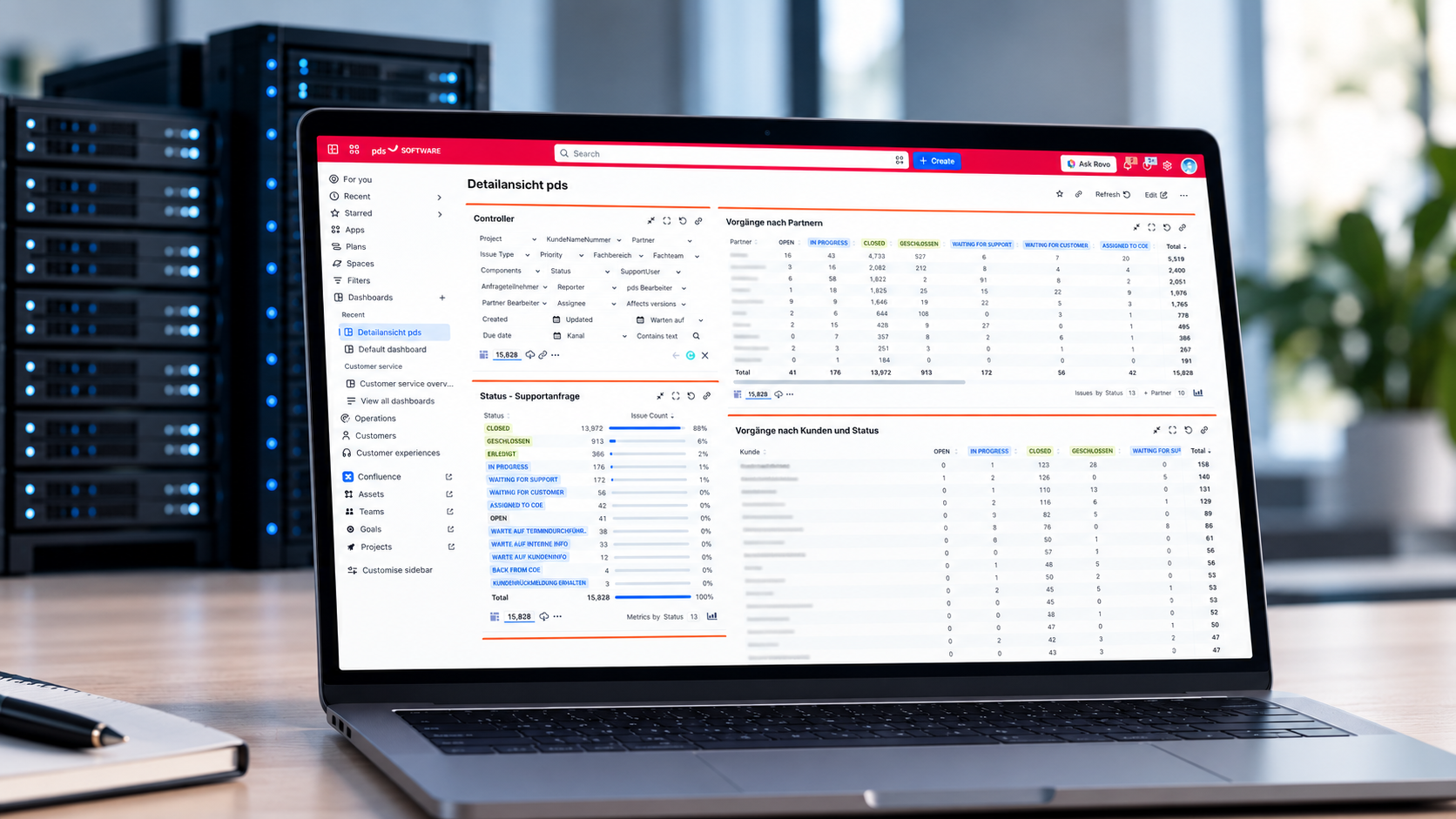
We also further developed and automated existing service processes. Atlassian Assets, Jira Automation, and new integrations ensure that information and workflows are now more closely interconnected. This results in faster response times, better coordination between application support, pds Software Consulting, and IT operations, as well as more reliable support for pds’s growing customer base.
The foundation of this modernization was the systematic inventory and evaluation of all existing systems, projects, integrations, data structures, and custom extensions. This comprehensive analysis made it possible to identify opportunities for transformation and to tailor the cloud solution optimally to pds’s requirements.
Throughout the entire transformation, we ensured that existing business processes were disrupted as little as possible
From the Server Environment to the Atlassian Cloud
- 1Analysis of the Existing System Landscape
Inventory and assessment of existing systems, projects, integrations, data structures, and custom extensions as the basis for the transformation.
- 2Development of the Target Cloud Architecture
Design of a future-proof cloud architecture, including governance, role, and authorization concepts.
- 3Preparing Data and Applications
Clean up and consolidate existing data, and set up test environments for the migration.
- 4Migration from Jira and Jira Service Management
A controlled and virtually seamless migration of the existing Jira and JSM environments to the Atlassian Cloud.
- 5Modernization of Custom Extensions
Adaptation of existing automation and integration systems, as well as implementation of modern cloud-based solutions.
- 6Process Optimization and Automation
Further development of service and business processes using Jira Automation, Atlassian Assets, and custom integrations.
- 7Knowledge Transfer and Continuous Improvement
Training for administrators and departments, as well as ongoing optimization of the platform following a successful migration.
The Benefits at a Glance
Cloud infrastructure reduces the effort required for operation and maintenance.
The platform can scale more easily to accommodate new requirements and use cases.
Standardized roles, rights, and governance structures provide a solid foundation.
Automation reduces the number of manual steps in service and business processes.
Teams and departments collaborate more efficiently on a central platform.
New features and integrations can be added flexibly.
Training enables teams to use the platform safely and competently.
The cloud provides a modern foundation for continuous development.
The result: A scalable platform for service and collaboration
With the completion of its cloud transformation, pds now has a modern Atlassian platform that centrally supports service management, project work, and collaboration.
The previous server infrastructure has been replaced, and the system landscape has been modernized at the same time. Standardized governance and authorization models simplify administration, while automation and integrations reduce manual process steps.
pds’s customers also benefit from this: More efficient service processes and better collaboration between application support, consulting, and IT engineering lay the foundation for faster problem resolution and scalable support.
Atlassian Cloud Migration: More Than Just a Technical Move
The transition to the Atlassian Cloud is rarely a simple migration. Workflows, integrations, and custom extensions that have evolved over the years must be reevaluated and adapted for the cloud in a meaningful way.
We help companies safely transition their existing Atlassian environments to the cloud while ensuring they’re ready for the future. In doing so, we use the migration to reduce technical legacy issues, automate processes, and establish structures for secure and scalable operations.
Here's what our customer says
LET'S TALK ABOUT YOUR CLOUD MIGRATION.